
Max drawdown is the biggest drop your account takes from a high point to a low point before it climbs back to a new high. Most prop firms do not kick you off a funded account for losing money overall, they kick you off for breaching that drawdown number, often set between 4% and 10% of your starting balance depending on the firm. A trader can be up on the month and still fail a challenge because one bad stretch pushed their equity curve too far below its last peak. Knowing the formula, seeing it worked out on a real account, and understanding how to actually use the number can keep you inside the rules instead of guessing at them.
Table of Contents
The Max Drawdown Formula You Need
The formula is simple: (Trough Value - Peak Value) / Peak Value x 100. Peak value is the highest your account balance has ever reached. Trough value is the lowest point it hits after that peak, before a new high gets made.
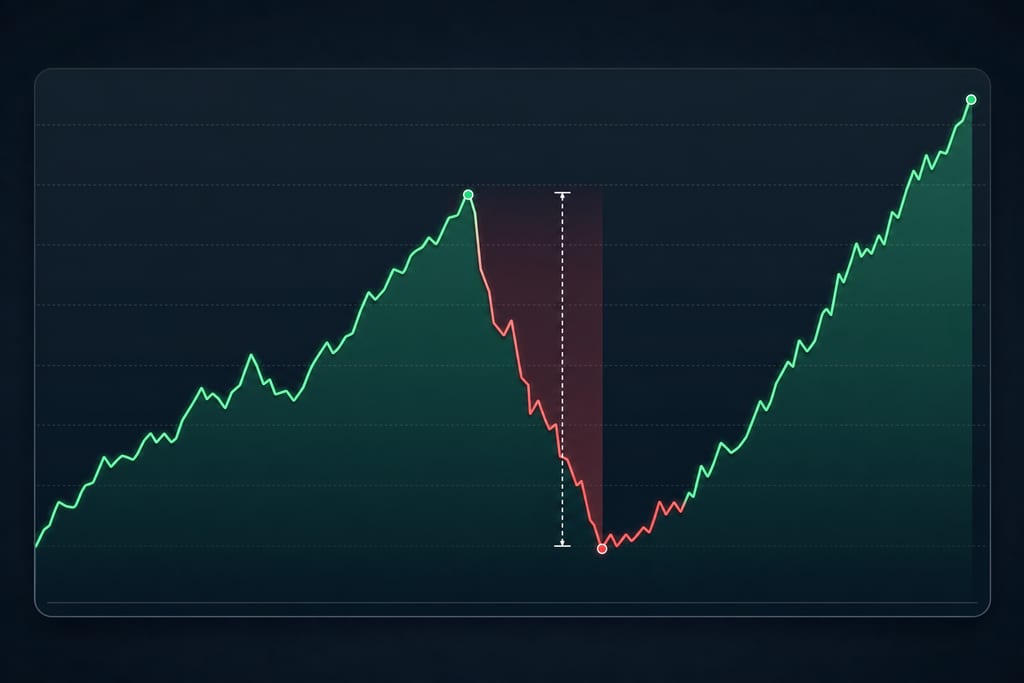
Think of peak equity as the highest number on your account statement, the one you'd screenshot if you were bragging. Trough equity is the lowest number your balance touches after that high point. The gap between those two numbers, divided by the peak, is your drawdown percent.
A rule traders miss a lot: drawdown is not the sum of every losing trade you've ever had. It resets the moment you hit a new account high. If your balance goes from $20,000 to $25,000, drops to $23,000, then climbs to $26,000, your drawdown measurement restarts fresh from that $26,000 peak. Only the drop from the most recent peak counts, not your worst day from three months ago.
- Peak value: the highest balance your account has hit so far
- Trough value: the lowest balance after that peak, before a new high
- Dollar drop: peak minus trough, in raw dollars
- Drawdown percent: dollar drop divided by peak, times 100
Traders who track this by hand often grab the wrong peak because they're looking at last month's high instead of the actual running high. The peak always updates upward, never down, so check your equity curve for the true high water mark before you run the math.
A Real Trading Example With Numbers
A $10,000 futures account that grows to $14,000 is sitting at a new peak. If that account then drops to $11,200 before recovering, the math is ($11,200 - $14,000) / $14,000, which equals -20% max drawdown. That 20% is measured off the $14,000 peak, not the original $10,000 starting balance, because the peak moved.
| Point | Balance | Dollar Change |
|---|---|---|
| Starting balance | $10,000 | - |
| Peak | $14,000 | +$4,000 |
| Trough | $11,200 | -$2,800 |
| Drawdown | -20% | based on peak |
Now run that same account through a prop firm challenge with a 10% max drawdown rule. That trader would have been pulled from the challenge the moment their balance touched $12,600, long before it ever dropped to $11,200. The eventual recovery back above $14,000 would not matter, because the breach already happened.
- Track your running peak daily, not just at month end
- Know your firm's exact drawdown percent before you size a trade
- Calculate the dollar trigger point in advance, not after a losing streak
- Remember that recovery does not undo a breach that already happened
What Counts as a Healthy Max Drawdown Number
A drawdown under 10 to 15% is generally considered manageable for most active traders. Once it climbs past 20%, that usually points to a sizing problem, a risk problem, or both, and it's worth stopping to look at position size before taking another trade.
Trading style changes what's reasonable. A scalper taking 20 trades a day with tight stops should expect a tighter drawdown band than a swing trader holding positions for days with wider stops and fewer total trades. Fewer trades and wider stops naturally produce bigger swings, so a swing trader running 15% is not automatically in worse shape than a scalper running 8%.
- Scalpers and day traders: tighter stops, expect lower drawdown tolerance
- Swing traders: wider stops, fewer trades, can tolerate higher numbers
- Prop firm traders: tolerance is set by the firm's rule, not personal preference
- Crypto traders: higher volatility often means wider natural swings
A single bad week is not the number that matters most. What matters is whether your drawdown trend is shrinking or growing over months, which is the kind of pattern MyTraderScore calculates automatically from a CSV upload, alongside win rate and profit factor, so you're not reconstructing it by hand after every losing stretch.
Set Your Hard Stop Before Your Next Session
Pull your last 20 to 30 trades right now and find your own peak and trough. Do the math from the formula above, then write down the dollar number where you'd have been breached. That number becomes your hard stop: if your balance touches it during a session, you're done for the day, no exceptions. Guessing at this after a losing streak is too late. MyTraderScore pulls peak, trough, and drawdown percent straight from a CSV export, so you get the number in minutes instead of building it in a spreadsheet.
Stop losing trades and start making more money.
Start freeMax Drawdown Questions Traders Ask
Does max drawdown include open floating losses or only closed trades?
Most prop firms and platforms count floating losses on open positions, not just closed trades. If your open position is down $500 and that drags your account balance below its last peak, that counts toward your drawdown the moment it shows on your equity, even before you close the trade. Check your firm's rule book, since some use end-of-day balance instead of real-time equity.
Can max drawdown look fine on a monthly chart but hide a bad intraday swing?
Yes, a monthly or daily chart can smooth over a sharp intraday dip that would have breached a drawdown rule in real time. If your firm measures equity tick by tick, a swing that happens and recovers within the same session still counts the moment it occurs. Pulling trade-level data instead of just daily closing balances is the only way to catch this.
Should I calculate max drawdown in dollars or percentage if my account size changes often?
Use percentage when your account size changes often, since it stays comparable even as your balance grows or shrinks from deposits and withdrawals. Dollar figures are useful for setting a hard stop on a single session, but they lose meaning once your starting balance has moved. Track both, but trust the percentage for comparing performance across different account sizes or time periods.